Different Types of Astrophotography Nights
Not every clear sky has the same job. Learn how to match the night to deep integration, exploration, testing, or planning.
The forecast finally looks clear, and your first instinct is understandable: this has to be a big night.
You start thinking about the most impressive subject you can find. Maybe a galaxy. Maybe a nebula you have seen online. Maybe something you tried once and want to improve.
But then the details show up. The clear part is only two hours long. The Moon is bright until midnight. The wind looks calm early but uncertain later. You are tired. Your setup needs a small adjustment. Suddenly the question is not just “Is it clear?”
The better question is: what kind of night is this?
A clear night is not automatically a deep night
Beginners often treat clear nights as rare treasures, which they are. But that can create pressure to make every clear night carry a serious imaging project.
That pressure can lead to frustrating choices. You try to gather deep data on a faint subject when the window is short. You push through wind because the sky looks good. You choose a difficult framing problem when what you really needed was a relaxed test night.
Not every night needs the same job. Once you give nights different purposes, planning becomes less stressful and more productive.
If you have already read about how conditions affect an imaging session, this is the next step: matching the conditions to the right kind of work.
Deep integration nights
A deep integration night is the classic dream: a long, steady stretch where you can collect meaningful time on one subject.
Integration just means combining many images so faint detail has a better chance to rise above the noise. A deep integration night is like giving bread dough enough time to rise. You can rush the process, but the result changes.
These nights usually benefit from:
- a long usable window
- low or manageable Moon impact
- steady wind
- reasonable humidity
- a subject that is well placed for several hours
- enough personal energy to monitor the setup calmly
Deep integration nights are especially valuable for faint broadband subjects, dim galaxy detail, reflection nebulae, dusty regions, and any project where you want smoother data over time.
The planning question is simple: do the best hours of the night line up with the subject you care about?
Survey and exploration nights
Some nights are not ideal for committing to one subject, but they are excellent for learning the sky.
A survey night is a tasting menu. You are not trying to finish a masterpiece. You are sampling subjects, checking framing, seeing what your site can handle, and building intuition.
Survey nights work well when:
- the clear window is real but short
- the Moon makes faint work less appealing
- you want to compare several possible subjects
- the sky is decent but not special
- you are new to a season and want to see what is available
This is a healthy use of time. Many good imaging projects begin as quick exploration. You might learn that a subject is larger than expected, sits too close to a light dome, clears your roof later than you thought, or looks better with a different setup.
The goal is not maximum data. The goal is better judgment for a future night.
Equipment, framing, and testing nights
Some nights are for the telescope, not the sky.
That can feel less glamorous, but it is often the reason future sessions improve. A testing night might be used to check focus behavior, update a workflow, compare filters, test a new tripod location, practice polar alignment, inspect cable routing, or learn how a subject frames with your current optics.
Think of it like tuning a bicycle before a long ride. The tune-up is not the ride, but the ride is better because of it.
Testing nights are useful when:
- conditions are clear enough to work but not strong enough for a serious subject
- wind or humidity makes long work risky
- the Moon is bright
- your setup has changed
- you want to practice without the emotional weight of a “perfect” night
For beginners, these nights are gold. They reduce friction. The next time a deep integration window appears, you are less likely to spend the best hour solving avoidable setup problems.
Closed nights
A closed night is a night you choose not to image.
That sounds negative, but it is not. A closed night can be one of the most productive nights in astrophotography if you use it well.
Closed nights are useful for:
- processing existing data
- reviewing what worked and what did not
- researching subjects for the next clear window
- building a short list for the month
- checking seasonal opportunities
- cleaning up files and notes
- resting so the next real session is more enjoyable
Clouds, high wind, heavy humidity, poor transparency, or a badly placed Moon can all point toward a closed night. The key is to treat the decision as planning, not failure.
One of the most important beginner skills is learning when not to force the sky. You do not lose progress by saving your energy for a better window.
The same night can change jobs
Night types are not permanent labels. A single night can shift.
Maybe early evening is good for testing while you wait for the Moon to set. Maybe midnight to 3 a.m. becomes a deep integration window. Maybe a planned deep session turns into a survey night because thin clouds arrive. Maybe the forecast collapses and the best choice becomes processing.
That is why observation windows matter. A night is not one solid block. It is a timeline.
When you look at the timeline, you can stop asking one all-or-nothing question and start asking better ones:
- What is the strongest part of the night?
- Is it long enough for the subject I want?
- What kind of work fits the weaker hours?
- Should I save the main idea for another date?
How AstroGuide helps you name the night
AstroGuide is designed around the idea that the night comes first.
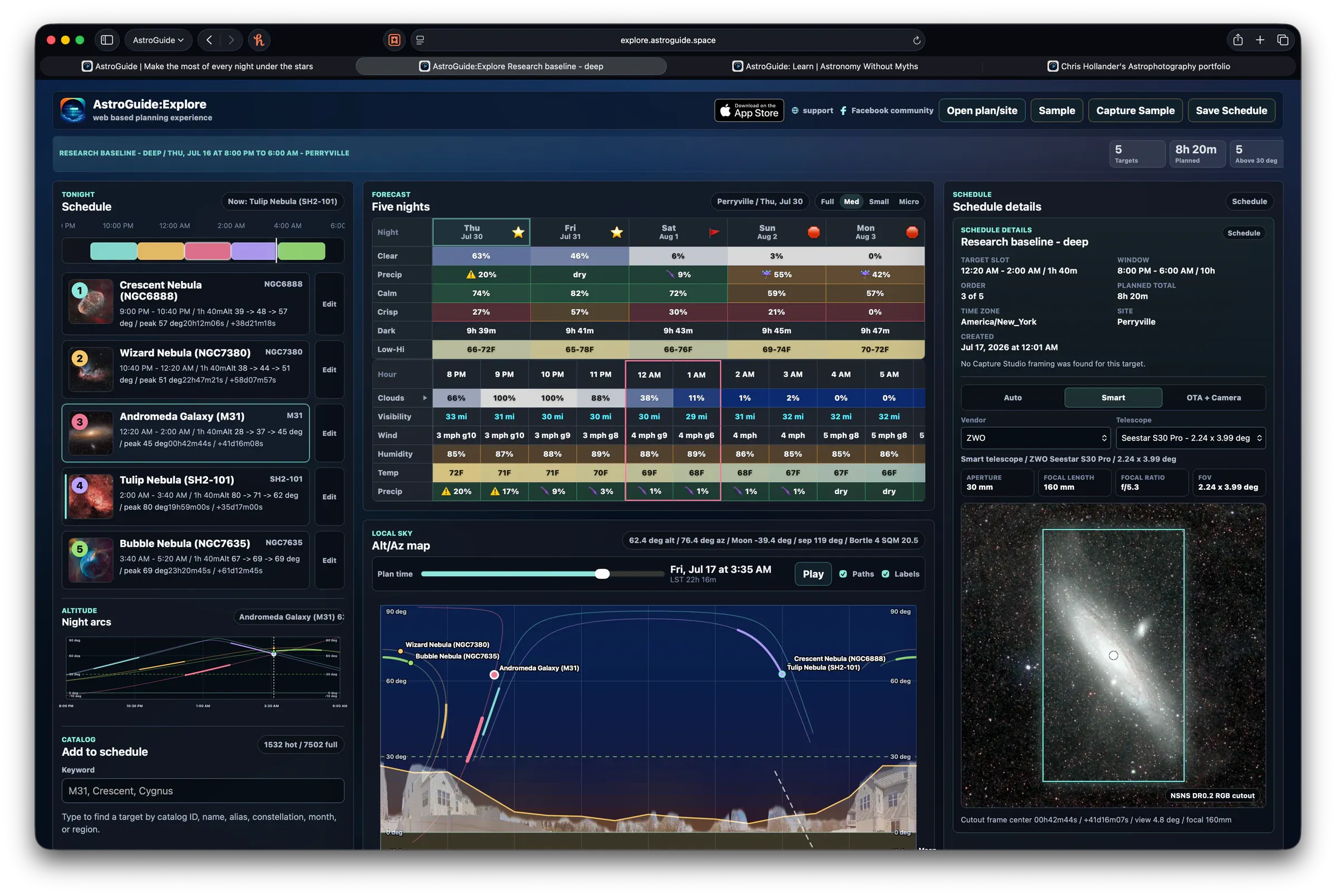
Night ratings help you understand the broad quality of the evening. Hourly conditions show where the night changes. Observation windows turn that changing forecast into practical blocks of time. From there, the app can help you decide whether the evening looks like a deep integration night, a survey night, a testing night, or a closed night.
The app sections support different kinds of nights in different ways:
- Tonight is where you decide what kind of evening you are dealing with. The Astronomic Forecast gives the broad read, the Hourly Forecast shows the changing details, and Observation Windows help you find the part of the night worth protecting.
- Tonight’s Schedule and the Schedule Preview chart are useful on deep integration nights because they turn a good window into an ordered plan instead of a loose idea.
- Search, including Browse by Type, Browse by Catalog, and Search Explore, fits survey nights. It gives you a calmer way to sample what is visible without pretending every interesting subject needs to become tonight’s main project.
- Target Detail is helpful on equipment and framing nights. The planning segment and Path Preview give you a place to inspect timing and practical constraints, while Capture Studio helps you think through composition, equipment, and filter choices before you commit.
- Goals & Objectives are ideal on closed nights. You can turn research into future intent, save subjects for a better Moon window, or keep multi-night projects organized while the weather does something unhelpful outside.
That distinction matters for beginners because it lowers the pressure. You do not have to make every clear night your best night. You only need to make the night useful for what it can reasonably support.
Once you start naming the kind of night you have, astrophotography becomes less like gambling on the weather and more like choosing the right tool for the job.