Choosing the Best Subject for the Night
A practical beginner guide to matching an astrophotography subject to altitude, Moon conditions, sky position, filters, and available time.
You open a catalog and the sky suddenly feels too big.
There are galaxies, nebulae, clusters, famous showpieces, beautiful images from other people, and dozens of subjects you have never heard of. The beginner problem is not a lack of choices. It is having too many choices without knowing which one fits tonight.
The best subject is not always the most famous subject. It is the subject that matches your sky, your time, your equipment, and your energy.
Start with the time you really have
Before choosing a subject, be honest about the imaging session.
Do you have five steady hours, or ninety minutes between clouds? Are you setting up before work tomorrow? Does the best part of the night happen after midnight? Is the Moon setting early enough to change the plan?
Time matters because deep-sky imaging rewards patience. A faint galaxy that needs a long calm window may not be the right choice for a short evening. A bright cluster, a familiar nebula, or a framing test may fit much better.
This is where the idea from different types of nights becomes useful. A deep integration night asks for a different subject than a survey night.
Choose subjects that climb, not just subjects that appear
Many beginner tools answer the first visibility question: is the subject above the horizon?
That is helpful, but it is not enough.
A subject low in the sky is seen through more air. The view is like looking across a lake instead of straight down into clear water. There is more atmosphere in the way, more haze, more glow, and more room for distortion.
The astronomy word for this is airmass. You do not need the math at first. Just remember the practical idea: higher subjects usually have a cleaner path through the atmosphere than low subjects.
Altitude also affects local obstacles. A subject that is technically visible at 18 degrees may still be behind trees, a roof, or a neighbor’s house. A subject that climbs to 60 degrees may give you a much cleaner imaging session.
For beginners, a simple habit helps: favor subjects that spend your best window comfortably above the horizon, not subjects that barely scrape into view.
Pay attention to where the subject sits in your sky
The sky is not equally good in every direction from a real site.
One side of your yard may face a city glow. Another may be blocked by trees. A subject to the south might be beautiful from one location and washed out from another. A subject to the east might be perfect after midnight but weak before then.
Sky position is the practical cousin of altitude. It asks: where will this subject be during the hours I can actually use?
This matters because distant light pollution often forms light domes near the horizon. If a subject is low over that glow, it may be harder than a subject in a darker direction, even if both are technically visible.
Good subject selection is local. It depends on your site, not just the catalog.
Match the subject to the Moon
Moonlight changes the kind of subject that makes sense.
Bright Moon windows are often harder for faint broadband work. Broadband means you are collecting a wide range of visible light, a bit like opening all the curtains in a room. Galaxies, reflection nebulae, faint dust, and subtle outer detail often depend on darker sky to stand out.
Narrowband is different. Narrowband imaging focuses on specific colors of light often produced by glowing gas. It is more like listening for one instrument in a noisy room. The noise is still there, but the instrument is easier to separate.
That is why emission nebulae can sometimes be more forgiving under moonlight when paired with an appropriate filter. It does not make the Moon irrelevant, and it does not guarantee a perfect image, but it can keep an imaging session useful when broadband subjects would struggle.
For beginners, the rule of thumb is:
- darker Moon windows are friendlier to galaxies, dust, and reflection nebulae
- brighter Moon windows may favor clusters, lunar work, testing, or narrowband-friendly emission nebulae
- the Moon’s position matters, not just its phase
Understand filters without making them mysterious
Light pollution filters are not magic. They do not erase bad conditions. They reduce or emphasize parts of the light reaching the camera.
Some filters try to reduce common artificial light pollution. Some focus on narrow bands from emission nebulae. Some smart-telescope and Seestar-style systems include built-in or integrated filter options that can make emission nebulae more practical from suburban skies.
The beginner-friendly way to think about filters is this:
- a filter can help the right subject under the right conditions
- a filter cannot make every subject equally good
- a filter usually helps emission nebulae more than galaxies
- a filter does not remove wind, clouds, dew, or poor placement
If you are choosing between subjects on a moonlit or light-polluted night, a nebula that works well with your available filter may be a better choice than a faint galaxy that needs clean broadband sky.
Do not fight the frame
A subject can be well placed and still be the wrong fit for your setup.
Some subjects are huge. Some are tiny. Some look best with surrounding dust or nearby companions. Some fit neatly in a small field of view, while others need a wide composition.
Framing is not just an artistic detail. It affects whether the imaging session feels satisfying. If a subject barely fits, you may spend the evening fighting composition. If it is much too small, you may gather clean data but feel underwhelmed by the result.
For beginners, a good subject is one that gives you a clear win:
- it fits the field of view
- it is high enough during the best hours
- it is not fighting the brightest part of your sky
- it matches the Moon and filter situation
- it suits the time you actually have
How AstroGuide helps narrow the choice
AstroGuide is built to reduce the “giant catalog” feeling.
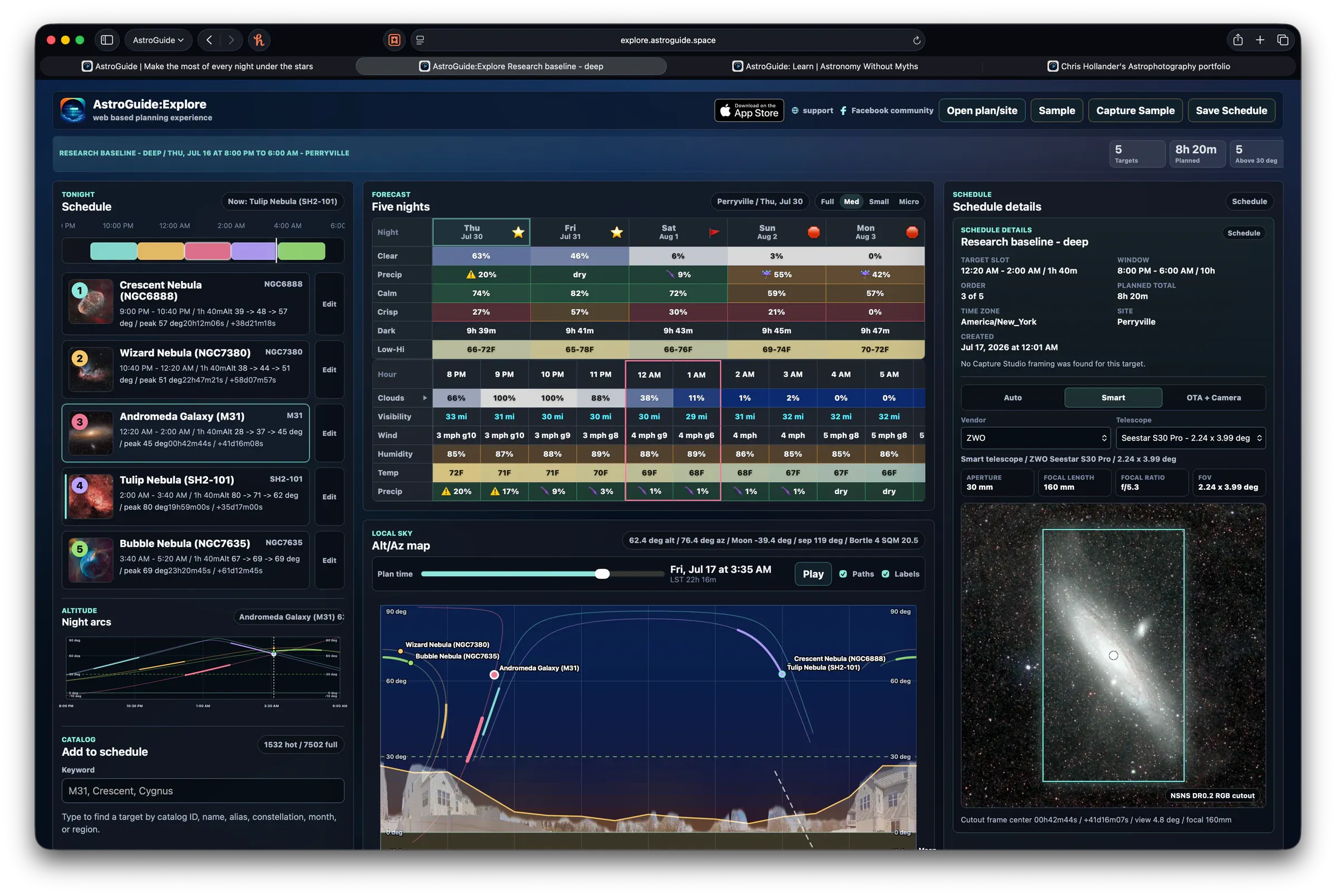
The app starts from the night, then connects conditions to practical subject choices. It considers the active site, equipment context, visibility, Moon and sky conditions, and the available observation window so the short list is shaped by reality rather than popularity alone.
When you are choosing one subject for one night, these sections are especially useful:
- Search is the discovery front door. Browse by Type, Browse by Catalog, search results, and planning-aware filters help you move from “everything in the sky” to a list that fits your date, site, and constraints.
- Target Detail is where a candidate becomes a real decision. The planning segment helps you inspect hourly visibility, timing, and how the subject behaves across the useful part of the night.
- Monthly visibility and lunar calendar views inside Target Detail help you decide whether the subject is better tonight, later this month, or during a darker Moon window.
- Path Preview helps you judge altitude, sky position, Moon context, and obstructions against the actual observation window.
- Sky Map and Sky Sphere are useful when you want to understand the subject in the larger sky, including nearby subjects, labels, filters, future dates, and site-aware sky context.
- Capture Studio helps connect the subject to the active equipment, composition, and filter context, so field of view and signal type stay part of the decision instead of becoming a surprise later.
That does not mean there is only one correct subject. Astrophotography always has room for preference and curiosity. But a calmer short list is easier to learn from than a thousand-object catalog.
When you understand why a subject fits the night, you also understand why another subject might be better saved for next week, next month, or a darker Moon window. That is the planning skill that keeps improving long after the first image.