Understanding Conditions for Better Astrophotography Nights
Learn how weather, moonlight, and light pollution shape an imaging session, and how beginners can make calmer planning choices.
You set the telescope outside, start thinking about a favorite nebula or galaxy, and then the doubts arrive.
The sky looks mostly clear. The Moon is up, but maybe not too bad. The forecast says the wind is “light,” whatever that means for a telescope. Your phone app says the humidity is rising. A neighbor’s porch light is on. A city glow sits low in the south.
So is this a good night?
Astrophotography beginners often hear advice that sounds simple: wait for clear skies. In practice, a clear night is only the beginning. The quality of an imaging session is shaped by several smaller conditions working together, a little like cooking. The recipe can survive one imperfect ingredient. Too many at once, and the result changes.
Clear is not the same as useful
Cloud cover is the first thing most people check, and for good reason. Thick clouds stop an imaging session outright. Thin clouds are trickier. They can let stars show through while still softening detail, reducing contrast, and making brightness change from one frame to the next.
If you are new, think of clouds like fingerprints on a window. You can still see the street outside, but the view is less clean. Your camera sees that too.
Clouds affect session quality because they decide how much useful light reaches the sensor. They can also affect how long each sub-exposure should be. A sub-exposure is one individual image inside a larger stack. If clouds are drifting through, longer sub-exposures have more time to be spoiled. Shorter sub-exposures may be more forgiving, though they do not magically fix bad sky.
Clouds also affect subject selection. A bright star cluster or the Moon can sometimes tolerate a hazy night better than a faint galaxy arm or a dim reflection nebula.
Wind is movement you may not notice until the stars tell you
Wind does not have to feel dramatic to matter. A telescope can act like a small sail, especially if it is on a lightweight tripod or exposed balcony. Even a gentle breeze can shake the setup enough to stretch stars or blur fine detail.
The everyday analogy is holding a camera while someone taps your elbow. The subject did not move, but the picture still suffers.
Wind can influence sub-exposure length because longer sub-exposures give motion more time to show up. If the wind is marginal, a beginner may be better served by shorter sub-exposures, a sturdier setup location, or a subject that does not require delicate detail. If the wind is strong or gusty, the best plan may be to skip the imaging session entirely and use the night for planning.
Wind also changes confidence. A night can look beautiful overhead and still be frustrating if every third frame is softened by vibration.
Humidity is the quiet condition
Humidity can be easy to ignore because it does not always look like a problem at the start of the evening. Then the telescope cools, dew forms, and suddenly the image looks washed out or foggy.
Think of humidity like bathroom mirror steam. The mirror is still there. The room is still lit. But the view loses crispness.
High humidity can affect session quality in two ways. First, it can make the sky less transparent, especially near the horizon. Second, it can put moisture on optics and accessories. Dew prevention helps, but planning still matters. A humid night may be usable for a shorter imaging session, a brighter subject, or equipment checks, while a drier night may be better for a long faint-object project.
Humidity also interacts with temperature. If conditions are dropping toward the dew point, the risk can rise later in the night. That means the best window may be earlier than the overall forecast suggests.
The Moon is a moving streetlight
The Moon is not simply “good” or “bad.” It is a bright light that changes shape, position, and timing. That makes it more like a moving streetlight than a fixed switch.
Lunar phase tells you how much of the Moon is illuminated. A full Moon throws much more light across the sky than a thin crescent. But lunar altitude matters too. A bright Moon low near the horizon may be less disruptive than the same Moon high above your subject. A Moon that sets before your best window may barely matter. A Moon that rises halfway through a faint galaxy session may change the plan.
Moonlight affects contrast. Faint dust, outer galaxy detail, and reflection nebulae can get harder to separate from the brightened sky. It can also influence sub-exposure length. Under brighter sky, the background fills in faster, so very long sub-exposures may become less useful than they would be under darker conditions.
Subject selection is where beginners can make the biggest improvement. During bright Moon windows, consider subjects that handle extra sky brightness better: star clusters, some emission nebulae with appropriate filters, the Moon itself, or equipment testing. Save faint broadband subjects for darker windows.
Local light pollution is the light near you
Local light pollution is the glow from nearby homes, streetlights, parking lots, signs, and buildings. It is the light that can shine directly into your setup or brighten the air around your site.
This kind of light pollution can be surprisingly practical. Sometimes the best improvement is not new gear. It is moving behind a fence, choosing the darker side of the yard, blocking a direct light, or avoiding a subject that passes over the brightest part of your local horizon.
Local light pollution affects session quality because it raises the background brightness. It can also create gradients, where one side of the image is brighter than the other. Gradients are harder on faint subjects and can make processing feel confusing.
For sub-exposure length, a brighter local sky usually means the background reaches a useful limit sooner. That does not mean the night is wasted. It means expectations and subject choice matter. Bright clusters, narrowband-friendly nebulae, and shorter exploratory sessions may make more sense than faint dust or delicate galaxy detail.
Distant light pollution is the glow on the horizon
Distant light pollution comes from towns and cities that may be miles away. You see it as a light dome: a broad glow near the horizon in a particular direction. It can be easy to miss if you only look straight overhead.
Imagine trying to photograph a candle in a room where one wall is glowing. The candle may still be visible, but the direction you face matters.
Light domes affect sky position. A subject in the darker part of your sky may be more rewarding than a technically higher subject sitting above a city glow. This is one reason planning by direction matters. South, north, east, and west are not equal from every backyard.
Light domes also change through the night as subjects move. A subject may start above a bright horizon and later climb into darker sky, or it may do the opposite. The best imaging session is often the part of the night where the subject is both high enough and away from the worst glow.
Conditions work together
The most useful planning habit is to stop judging each condition alone.
A half Moon, low humidity, calm wind, and a bright emission nebula can still make a satisfying evening. A moonless night with gusty wind, rising humidity, and a subject above a city dome can be disappointing. A mediocre forecast may be perfect for testing focus, framing, or a new workflow.
This is why beginners should think in tradeoffs:
- Session quality: How likely are the frames to be steady, clean, and consistent?
- Sub-exposure length: Will the sky background, wind, or clouds reward shorter or longer individual frames?
- Subject selection: Does the subject match the sky you actually have?
- Timing: Is there a cleaner window later, or is the best part early?
You do not need to calculate all of this with dense math. You only need to build the habit of asking better questions before committing the night.
How AstroGuide helps
AstroGuide is built around that habit. Instead of starting with a giant catalog and leaving you to wonder whether the night can support your idea, it starts with the night itself.
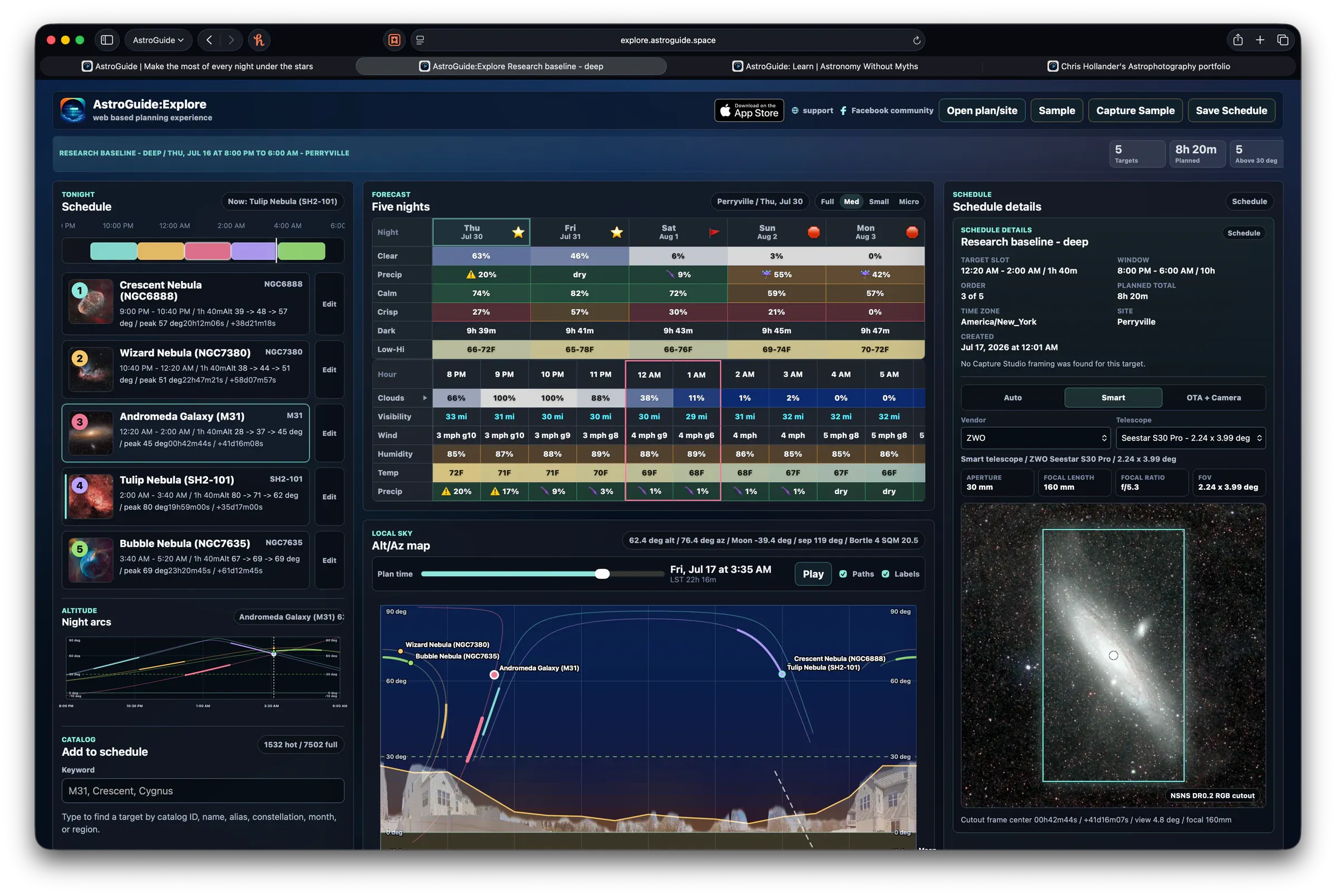
The app brings together weather, moon context, site context, sky brightness, and observation windows so you can see the shape of the evening. A night rating gives the big picture. Hourly conditions show when the night improves or weakens. Observation windows translate that into blocks of time you can actually use.
In the app, those tradeoffs show up in a few specific places:
- Tonight is the main starting point. The Astronomic Forecast, Hourly Forecast, and Observation Windows sections help you see whether the evening is generally promising or only useful during a smaller block.
- Observation Windows help turn a messy forecast into practical time ranges. This is where wind, humidity, Moon timing, and changing sky conditions become easier to compare.
- Sites keeps the local context close to the plan. Site detail, Bortle/map context, obstructions, and the Light Dome Map help explain why one direction from your yard may be better than another.
- Path Preview, Sky Map, and Sky Sphere help connect conditions to the actual sky. Moon paths, sky-brightness gradients, and obstruction overlays make it easier to see whether a subject is not just visible, but practical.
- Target Detail brings the decision down to one subject. The planning view can help you inspect timing, visibility, and whether the subject belongs in tonight’s window or a future plan.
From there, subject planning becomes calmer. Maybe tonight supports a long imaging session. Maybe it is better for a bright subject. Maybe it is a good night for testing equipment. Maybe the best choice is to wait for a darker Moon window.
The goal is not to make the sky feel simple. The goal is to make the tradeoffs easier to understand, one night at a time.