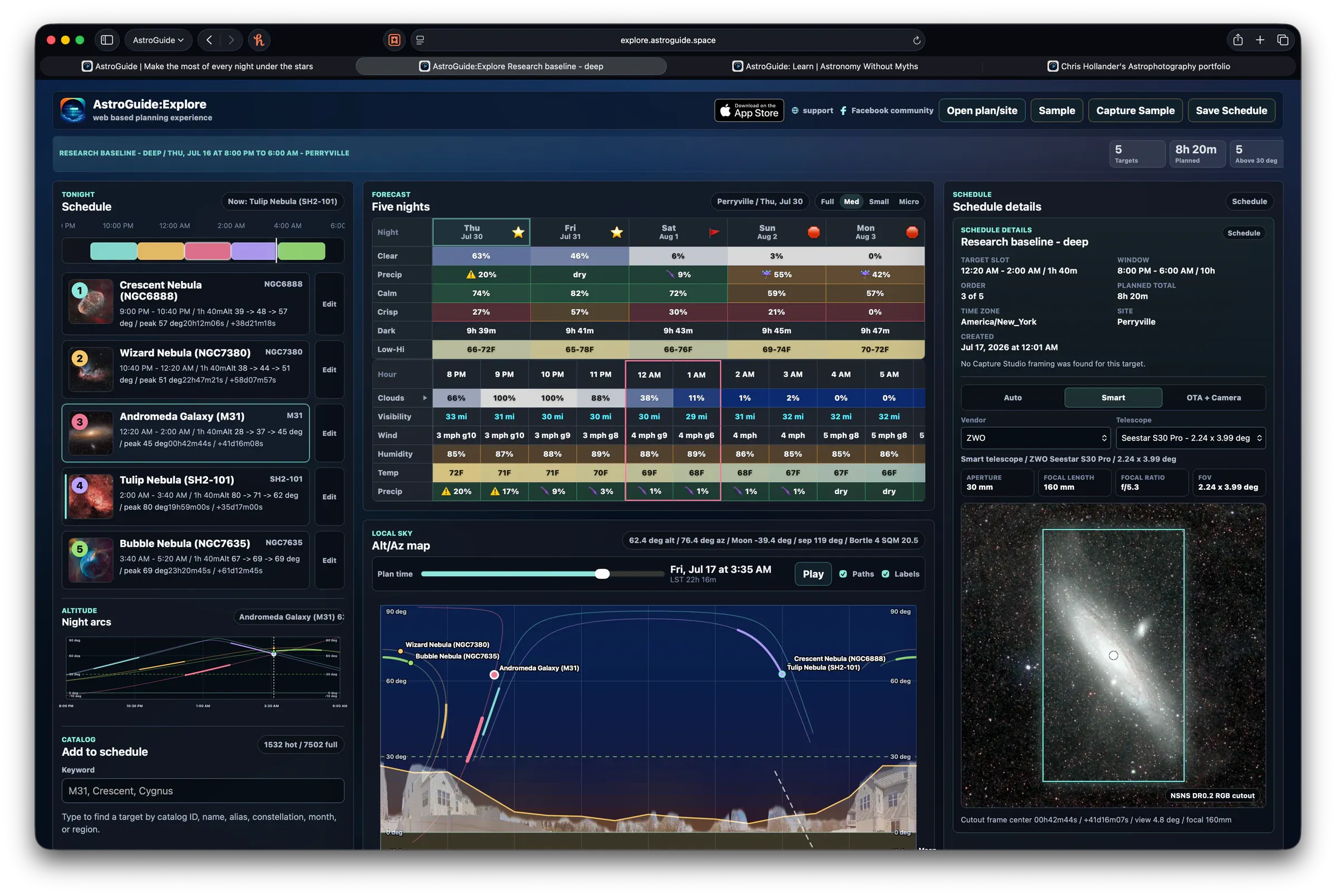
How AstroGuide helps you decide what kind of night you have
A closer look at the planning loop that starts with the night itself, narrows to practical subjects, and helps you learn from the session afterward.
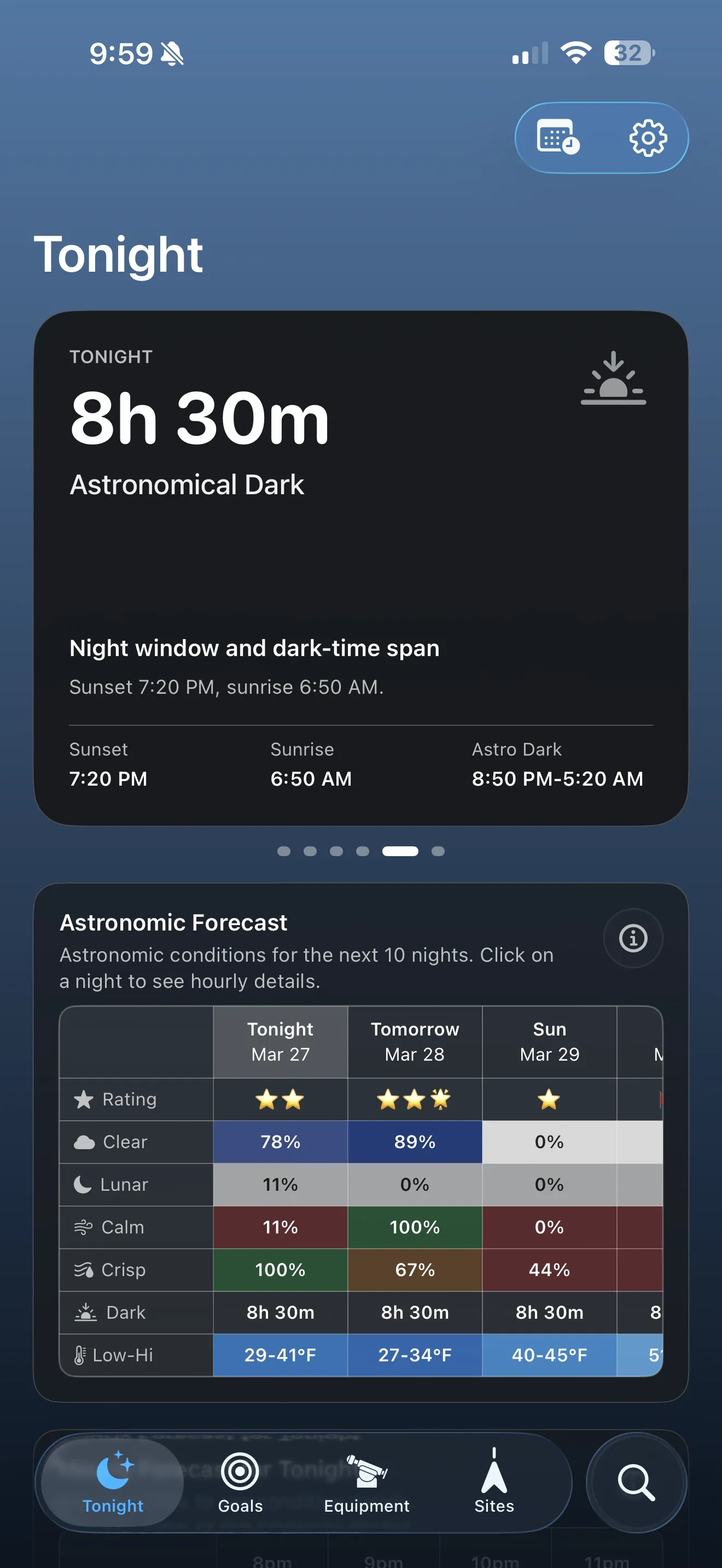
When people first open AstroGuide, one of the most important shifts is also one of the simplest: the app does not start by throwing a giant catalog of subjects at you.
It starts with the night.
That sounds small, but it changes the whole planning loop. A lot of observing tools begin from the assumption that the main question is which subject do you want? AstroGuide tries to answer a different question first: what kind of night do you actually have?
Start with the night, not the catalog
On some evenings, the answer is easy. The sky is steady, the useful hours are clear, and there is enough time to commit to a meaningful subject.
On other evenings, the answer is more nuanced:
- the first part of the night is mediocre, but conditions improve later
- the moon is bright enough to change what is practical
- you have a short window, not a full session
- the forecast is uncertain, but there may still be a worthwhile opportunity
- the best use of the evening may be planning ahead or reviewing past work
AstroGuide is built around that real-world spread. The goal is not to treat every night like an all-or-nothing event. The goal is to help you make a good decision with the conditions you actually have.
What AstroGuide is trying to understand
Before it starts nudging you toward a subject, AstroGuide is trying to build context around a few practical questions:
- How strong does the night look overall?
- Which hours appear most usable?
- Is this a night for active observing, a shorter opportunistic session, or calmer planning?
- Which subjects fit your site, visibility, and equipment instead of an imaginary ideal setup?
That context matters because a subject can be technically visible and still be a bad choice. It might clear your obstruction too late. It might not fit the telescope you are using. It might be available during the wrong part of the night. It might simply not match the kind of session the conditions support.
AstroGuide tries to keep those realities close to the decision.
Why that matters for newer smart-telescope owners
If you are newer to the hobby, planning can feel deceptively binary. Either you pick a famous subject and hope for the best, or you feel like you need much deeper expertise before you can make good choices.
AstroGuide is meant to ease that gap.
Instead of acting like a black box, the app is designed to explain what it is seeing:
- why the night looks strong or limited
- when the useful part of the evening really begins
- why one subject is more practical than another
- when a tempting idea belongs in a future objective instead of tonight
That explanation layer matters just as much as the recommendation layer. Over time, the aim is not just to help you choose better sessions. It is to help you understand why those choices make sense.
When the best answer is “not tonight”
One of the easiest ways to waste energy in astronomy is to force tonight to carry every good idea.
Sometimes the best call is to save an observation subject for a cleaner window, move it into a goal, or keep the evening focused on review and preparation. AstroGuide is intentionally designed to treat that as progress, not failure.
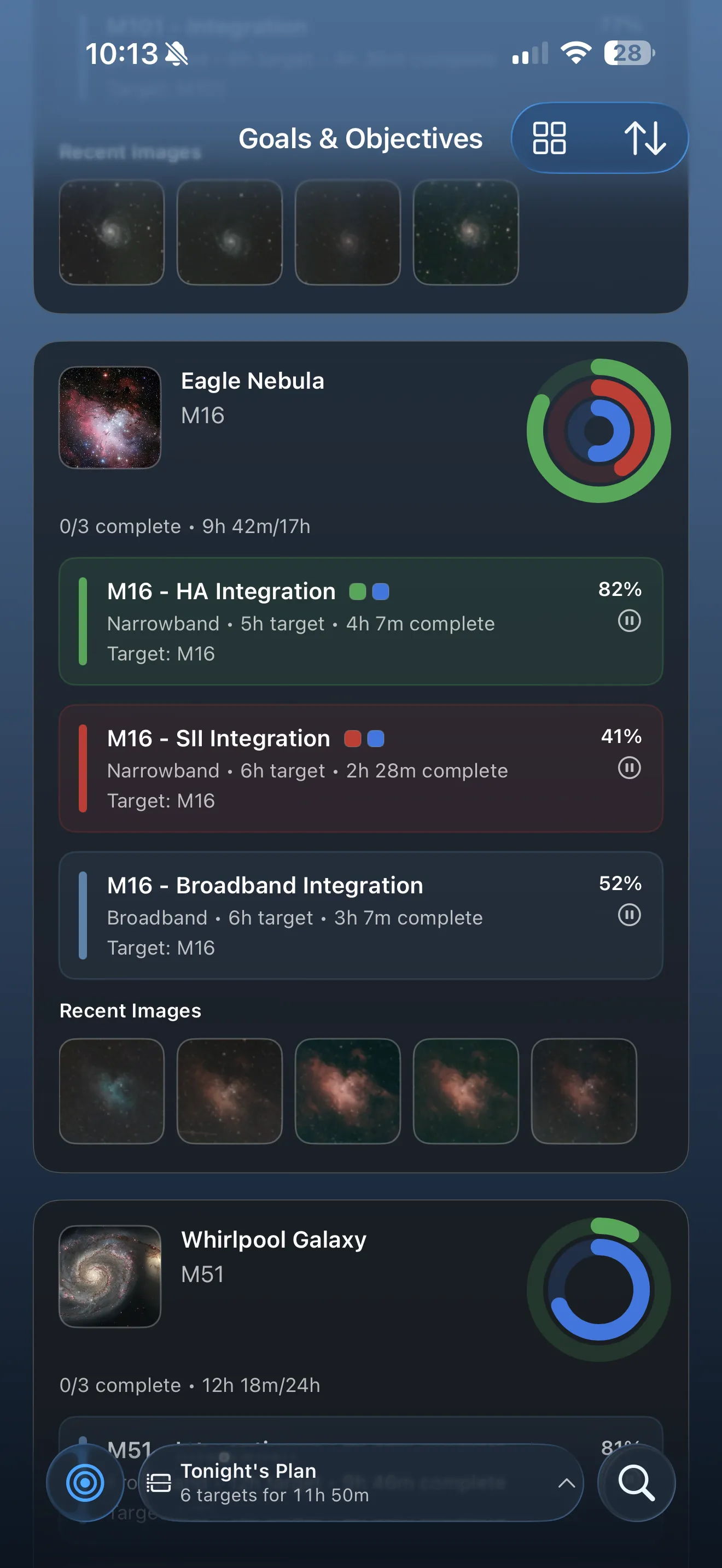
That is a big part of what we mean when we say the app helps you make the most of every night. Some nights are for active observing. Some are for protecting a narrow good window. Some are for learning from what already happened and making the next session better.
All of those count.
The loop does not stop when the session ends
The other half of this workflow is what happens after the telescope is packed away. AstroGuide is not only about deciding what to do next. It is also about building better judgment from one night to the next.
That is why session review, grouped captures, and efficiency views belong in the same product loop. Planning gets better when it can look backward as well as forward.
The more clearly you can see what actually worked, the easier it becomes to recognize the right kind of night the next time around.